


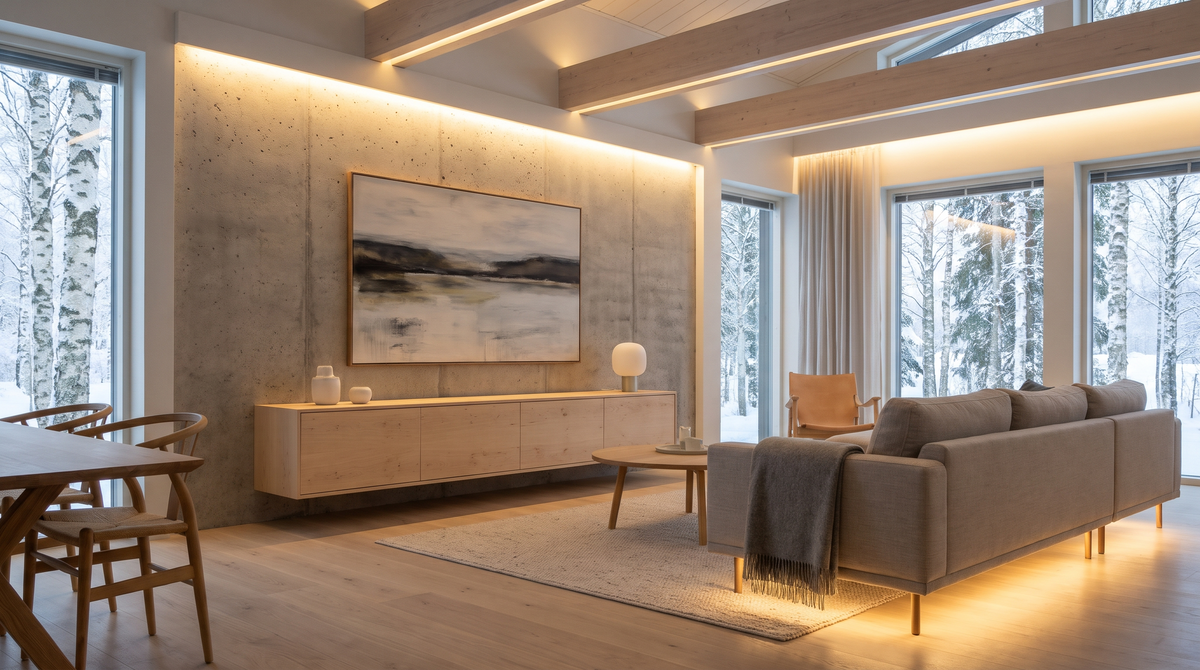
When Does LED Strip Lighting Really Save Energy – and Why Choose It?
LED strip lighting saves energy compared to traditional lighting solutions when you select the optimal power output for your space and use the strips sensibly. Over the long term, savings show up not only in your electricity bills but also through reduced maintenance costs. In European homes, where energy prices continue to rise, making smart lighting choices has become more important than ever.
The key to maximising savings lies in understanding your actual lighting needs. For instance, in a kitchen where you need bright task lighting for food preparation, a high-efficiency LED strip running at 10-14 W/m might be perfect. Meanwhile, in a living room where you want ambient accent lighting behind a TV unit or under shelving, a lower-power strip at 5-8 W/m could deliver the atmosphere you need while consuming minimal electricity.
How Does LED Strip Energy Efficiency Differ from Other Lighting Solutions?
LED strips are fundamentally more energy-efficient than halogen or fluorescent tube fixtures. A single LED strip's power consumption can be just a fraction of older technologies whilst delivering equivalent light output. This stems from LED technology's architecture: virtually all electrical energy converts to light, whereas in older solutions, a significant portion transforms into waste heat.
Consider a practical example: a traditional halogen strip light in a 3-metre under-cabinet installation might consume 150-200 watts, generating considerable heat that can damage kitchen cabinetry over time. An equivalent LED strip installation would typically use only 30-45 watts whilst producing the same or better illumination, staying cool to the touch, and lasting 15-20 times longer. For a typical European household running such lighting 3-4 hours daily, this translates to annual savings of approximately 120-150 kWh – enough to power a modern refrigerator for several months.
The heat reduction benefit is particularly valuable in European climates. During summer months, traditional lighting contributes to indoor heat buildup, potentially increasing air conditioning costs. LED strips eliminate this problem entirely, maintaining comfortable room temperatures whilst reducing overall energy demand.
How Do I Compare Power Consumption and Efficiency Between LED Strips in Practice?
Comparing LED strip energy efficiency is easiest when examining their power consumption (W/metre) and luminous flux (lm/metre). The higher the lm/W ratio, the more efficiently the strip converts electricity into visible light. When making purchasing decisions, check these values in manufacturer specifications rather than judging solely by appearance or price.
Generally, a lower-power strip that produces high-quality light delivers the best value for European homes. Look for strips offering at least 80-100 lumens per watt – modern high-efficiency models can achieve 120-140 lm/W or higher. For context, older LED technology might only deliver 60-70 lm/W, whilst halogen strips rarely exceed 15-20 lm/W.
Also consider the colour rendering index (CRI). A strip with CRI >90 renders colours more naturally, meaning you can achieve your desired lighting effect with lower overall brightness – and therefore lower power consumption. In spaces like dining rooms, retail displays, or bathrooms where accurate colour perception matters, this becomes especially relevant.
When calculating real-world efficiency, remember to factor in the power supply unit. A quality driver with >85% efficiency ensures minimal energy waste during voltage conversion. Cheap power supplies can waste 20-30% of input power as heat, completely undermining your LED strip's inherent efficiency advantages.
Can LED Strips Deliver Real Savings in European Homes?
Real savings emerge when considering total lifecycle costs: electricity consumption, installation simplicity, and operational lifespan. If you run LED strips unnecessarily at excessive power levels or leave lights on when not needed, much of the savings potential disappears. However, properly sized LED strips matched to your space and usage patterns deliver concrete savings, especially when replacing traditional light sources.
Energy-efficient planning and quality control solutions elevate savings to the next level. For example, integrating motion sensors in hallways or staircases ensures lights operate only when needed – in a typical home, this can reduce lighting energy consumption in these areas by 70-80%. Similarly, wireless motion sensors in wardrobes, storage rooms, or utility spaces eliminate the common problem of forgotten lights burning unnecessarily for hours.
Smart dimming systems offer another savings layer. During evening hours when full brightness isn't needed, dimming LED strips to 50% typically reduces power consumption by 40-50% – the relationship isn't linear due to LED driver efficiency curves. Over a year, this adaptive approach can cut lighting costs by 30-40% compared to fixed full-brightness operation.
In countries with time-of-use electricity tariffs, intelligent control systems can automatically adjust lighting levels or schedule non-essential lighting during off-peak hours when electricity costs less. This strategic approach maximises both energy and financial savings.
What Affects Real LED Strip Energy Consumption at Home?
Consumption depends on power supply efficiency, strip length, installation location, and usage frequency. Long strips or incorrectly configured systems can significantly increase consumption. Adjustability, dimming, and smart controls enable additional savings – for instance, timers and motion sensors ensure lights operate only when genuinely needed.
Installation quality also impacts efficiency. Voltage drop in longer runs forces LED chips to work less efficiently, potentially requiring higher overall power input for desired brightness. This is why choosing appropriate cable thickness and considering 24V systems instead of 12V for runs exceeding 3-5 metres matters significantly.
Ambient temperature affects LED efficiency too. Strips installed in locations with good airflow and heat dissipation maintain optimal efficiency, whilst those trapped in confined spaces without adequate cooling can experience efficiency degradation over time. Using aluminium profiles not only improves light distribution but also acts as a heatsink, maintaining peak efficiency throughout the strip's lifetime.
The control system you choose plays a crucial role. Simple on/off switches waste potential, whilst advanced dimming controllers allow precise power management. Smart systems can reduce average daily consumption by 25-50% through automatic adjustment based on time of day, occupancy, and natural light levels.
| Lighting Solution | Power Consumption (W/metre) | Estimated Lifespan | Maintenance Costs |
|---|---|---|---|
| LED strip | Low–Moderate | Long (30,000–50,000h) | Low |
| Halogen strip | High | Short (2,000–4,000h) | High |
| Fluorescent tube array | Moderate | Medium (8,000–15,000h) | Moderate |
What Should I Consider When Optimising LED Strip Energy Efficiency?
Achieve optimal energy efficiency by selecting strips matching your space's purpose and required light output. Avoid over- or under-powering – even the most efficient strip wastes energy if delivering excessive light or directing it poorly. Automatic shutoff, dimming, and control systems help leverage LED lighting's full savings potential.
Zone your lighting thoughtfully. Instead of illuminating an entire room uniformly, create task-specific lighting zones. For example, in an open-plan kitchen-dining area, use brighter strips (12-14 W/m) over work surfaces where precision tasks occur, moderate strips (8-10 W/m) for general dining ambience, and accent strips (4-6 W/m) for decorative elements. Each zone can operate independently, ensuring you only consume power where and when needed.
Consider tunable white LED strips for spaces used throughout the day. These allow adjusting both brightness and colour temperature, letting you use cooler, energising light (4000-5000K) during daytime work hours, then switch to warmer, relaxing tones (2700-3000K) for evening relaxation – often at reduced power levels since warmer tones typically feel adequately bright at lower intensities.
- Check the strip's luminous efficacy and power consumption (lm/W – lumens per watt) – aim for at least 100 lm/W for modern efficient strips
- Select colour temperature suited to the space's purpose – warm white (2700-3000K) for living areas and bedrooms, neutral (4000K) for kitchens and workspaces, cool white (5000K+) for task-intensive areas like workshops
- Use aluminium profiles when necessary for thermal management, extending lifespan and maintaining efficiency – especially important for high-power strips exceeding 10 W/m
- Position fixtures so light reaches exactly where needed, avoiding wasteful spillage or misdirection – proper placement can reduce required power by 20-30%
- Implement control systems for energy optimisation – automatic dimming based on daylight availability, occupancy sensors, or scheduled operation via smart home integration
- Choose appropriate voltage (12V vs 24V) based on run length – 24V systems reduce resistive losses in longer installations, improving overall efficiency
- Invest in high-quality power supplies with >85% efficiency ratings and adequate capacity without extreme oversizing, which can reduce driver efficiency
How Do I Plan Energy-Efficient LED Strip Lighting at Home? (Checklist)
- Map out space usage: do you need ambient lighting, task lighting, accent lighting, or combinations? Different purposes require different power levels and distributions
- Measure required strip length accurately and estimate light quantity needed – avoid unnecessary over-specification that wastes power. Use lighting calculation tools or consult specifications for recommended lux levels
- Select high-quality power supplies: efficient transformers minimise conversion losses. Look for units with power factor >0.9 and efficiency ratings >85%
- Consider dimming capability and potentially smart control via systems like Bluetooth mesh, Zigbee, or 0-10V protocols. Quality LED drivers with dimming support offer both control flexibility and energy savings
- Use aluminium profiles where appropriate for more effective cooling and extended lifespan – this maintains efficiency throughout the product's life and improves light distribution quality
- Plan installation so light directs toward intended surfaces, avoiding glare and wasted illumination. Diffusers can improve light distribution whilst reducing perceived brightness requirements
- Design control zones logically – group lights by usage patterns rather than physical proximity. For example, under-cabinet kitchen strips might operate independently from plinth lighting or display cabinet illumination
- Calculate payback period: compare upfront investment against projected energy savings. Most quality LED strip installations in European homes achieve payback within 18-30 months when replacing halogen or fluorescent solutions
- Plan for flexibility: install switching and control infrastructure that allows future adjustments as usage patterns evolve, potentially integrating wireless rotary dimmers for intuitive brightness control
What Are the Most Common Mistakes That Reduce LED Strip Energy Savings?
Common mistakes include selecting overpowered strips, inadequate control systems (e.g., lights left on unnecessarily), and poor-quality or inappropriate power supplies. Positioning also matters critically: if light projects in wrong directions, you'll need more power to achieve desired results. Careful planning pays back quickly through energy savings.
One frequent error in European homes is treating all LED strips as equivalent. A cheap strip claiming similar specifications to a quality product often delivers disappointing real-world performance – lower actual light output, poor colour quality, and inferior efficiency. This forces users to install additional lighting or run strips at higher power levels, negating efficiency advantages.
Improper installation creates another efficiency pitfall. Strips installed without adequate heat dissipation experience accelerated degradation, requiring replacement sooner and delivering reduced light output (and therefore reduced efficiency) throughout their shortened lifespan. Always follow manufacturer guidelines for maximum run lengths, appropriate mounting surfaces, and thermal management requirements.
Neglecting control systems represents perhaps the biggest missed opportunity. Even the most efficient LED strip wastes 100% of its consumption when burning unnecessarily. A moderately efficient strip with smart controls consistently outperforms a high-efficiency strip operated manually. Motion sensors in circulation spaces, daylight sensors near windows, and scheduled operation for predictable usage patterns can collectively reduce consumption by 40-60%.
Finally, many people underestimate the importance of proper dimming. Not all dimmers work optimally with all LED strips – incompatible combinations can cause flickering, limited dimming range, or even increased standby consumption. Ensure your dimming solution matches your LED strip specifications, or consider integrated systems designed to work together seamlessly.
How Do LED Strip Technical Choices Like Voltage and Control Systems Affect Energy Efficiency?
Operating voltage (e.g., 12V vs 24V) primarily affects strip length and potential voltage drop. In longer runs, higher voltage can reduce resistive losses. Control systems (e.g., DALI, Zigbee, KNX, or Bluetooth mesh) enable intelligent lighting adjustment, allowing power consumption to adapt to situations – for instance, when dimmed, consumption often decreases substantially.
The voltage choice becomes particularly relevant in larger installations. A 12V system might experience noticeable brightness variation across a 5-metre run, whilst a 24V system maintains uniformity. This isn't just aesthetic – it's an efficiency issue. Users compensate for dim sections by over-driving the entire strip, wasting energy. In residential applications, 24V systems generally offer better efficiency for runs exceeding 3 metres.
Control protocols offer varying efficiency benefits. Basic PWM (pulse width modulation) dimming is simple and effective, reducing power consumption proportionally with brightness reduction. More sophisticated protocols like DALI or 0-10V allow precise control and can integrate with building management systems for optimised scheduling and occupancy-based operation.
Wireless control systems have revolutionised residential LED efficiency. Rather than requiring complex wiring, modern Bluetooth mesh or Zigbee solutions allow creating sophisticated lighting scenes and automation without installation complexity. Users can easily implement time-based dimming schedules, gradually reducing brightness as evening progresses, then automatically switching off at bedtime – all manageable via smartphone apps.
For those seeking maximum integration and control flexibility, exploring dedicated smart lighting ecosystems makes sense. Systems offering scene control, scheduling, and sensor integration transform LED strips from simple lights into responsive, efficient components of your home environment. The energy savings from intelligent control typically exceed any marginal efficiency differences between good-quality LED strips themselves.
Where Can I Find Energy-Efficient LED Strips and Planning Guidance?
From comprehensive LED strip ranges, you'll find options designed for different characteristics and applications. Professional suppliers offer technical specifications allowing informed efficiency comparisons, along with compatible control systems, power supplies, and accessories needed for optimised installations.
When selecting products, prioritise suppliers providing complete technical data: not just basic wattage, but luminous efficacy (lm/W), CRI values, beam angles, and thermal requirements. This transparency indicates quality products backed by proper engineering rather than marketing claims alone.
Consider complete system solutions rather than mixing components from various sources. Matched LED strips, drivers, and controls designed to work together deliver predictable performance and optimal efficiency. For example, complete LED lighting kits eliminate compatibility concerns whilst ensuring all components meet consistent quality standards.
Don't hesitate to request application advice for specific installations. Professional suppliers can recommend appropriate power levels, control options, and installation approaches for your particular requirements – helping you avoid common mistakes whilst maximising both lighting quality and energy efficiency. The small time investment in proper planning delivers years of efficient, reliable operation and substantial energy cost savings.


0 comments