


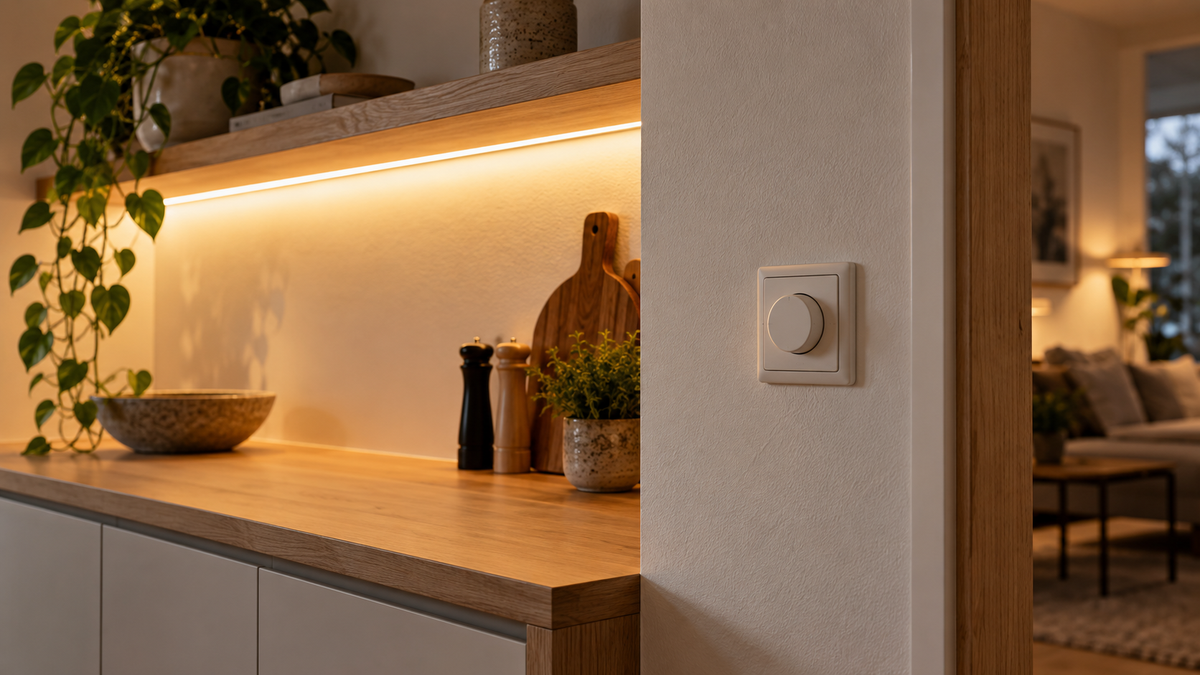
Summary: A TRIAC dimmer is a traditional wall-mounted dimming solution that can be used with LED lighting when the luminaire or LED power supply is compatible. For LED strips, TRIAC dimming typically requires a dimmable TRIAC-compatible LED power supply. Valotehdas offers LED strips, power supplies, profiles and control solutions where compatibility is the most important consideration.
The TRIAC dimmer is familiar to many as a rotary or push wall controller. The same dimming method can work well with LED lighting, but only when all components are correctly matched. A standard LED strip cannot be connected directly to a 230V TRIAC dimmer. An appropriate dimmable power supply is needed in between to convert the 230V input to, for example, a 24V constant voltage suitable for the LED strip.
This guide covers when a TRIAC dimmer is suitable for LED lighting, the difference between leading edge and trailing edge dimming, how to size an LED strip power supply, and when to consider alternative control methods.
What is a TRIAC Dimmer?
A TRIAC dimmer controls light by cutting the mains voltage sine wave. In older incandescent and halogen fixtures, this was a very common dimming method. With LED lighting, the load is different, which is why compatibility must be checked on a product-by-product basis. If the dimmer, power supply and LED load are not compatible, the result may be flickering, limited dimming range, buzzing or premature light cut-off.
| Term | What it means | Why it matters |
|---|---|---|
| TRIAC | Dimming method operating on the 230V side | Requires LED-compatible load or power supply |
| Leading edge dimming | Leading edge-type control | Suitability depends on power supply and load |
| Trailing edge dimming | Trailing edge-type control | Alternative used in many LED applications |
| Minimum load | Load required for the dimmer to function | Too small an LED load can cause problems |
When is a TRIAC Dimmer Suitable for LED Strips?
TRIAC dimming is suitable for LED strips when using a TRIAC-dimmable LED power supply. For example, a 24V LED strip requires a 24V power supply. If you want to control the lighting with a wall dimmer on the 230V side, the power supply must be specifically designed for this purpose.
Valotehdas 24V TRIAC power supplies are the starting point when you want to control LED strips with a traditional wall dimmer. A standard non-dimmable power supply is generally not suitable for TRIAC dimming.
TRIAC or PWM Dimming?
With LED strips, it's important to distinguish between two points where dimming can occur. In TRIAC dimming, control happens before the power supply on the 230V side. In PWM dimming, control happens on the low-voltage side of the LED strip, for example at the 24V output. Both can be effective, but they should not be mixed without proper planning.
| Control method | Location in system | Particularly suited to | Note |
|---|---|---|---|
| TRIAC | 230V before power supply | When using an existing wall dimmer | Requires TRIAC-compatible LED power supply |
| PWM | 24V low-voltage side | LED strips, CCT, RGBW and smart control | Requires appropriate controller for LED strip type |
| Casambi or other smart control | Usually via controller | Multiple groups, lighting scenes and app control | Compatibility must be determined as a complete system |
Power Supply Sizing for TRIAC Dimming
LED strip power supply sizing follows the same principle as other LED strip installations. Multiply the LED strip power by the length in metres and add approximately 20–30% headroom.
Example: LED strip 9.6 W/m × 5 m = 48 W. In this case, select a power supply of at least approximately 60 W rating, if the product's technical specifications and load allow. If using 14.4 W/m strip for 5 metres, the load is 72 W and the power supply should be selected from a higher power rating.
Valotehdas LED power supplies and TRIAC power supplies should be selected together with the LED strip length and power. If there are multiple LED strips in the installation, loads are added together.
Most Common Problems with TRIAC Dimming
TRIAC dimming problems are most often related to compatibility. The LED load is small and electronic, so not all old dimmers work as well with LEDs as they did with incandescent lamps. The power supply's minimum load, maximum load and dimming type also affect the end result.
- Light flickers at low dimming levels.
- Light doesn't turn on at low settings.
- Dimming range is too narrow.
- Power supply or dimmer makes noise.
- LED strip doesn't turn off completely.
- Light becomes uneven in long runs.
If the aim is a wide adjustment range and multiple lighting scenes, PWM or smart control may be more flexible than a TRIAC solution. However, if there is already a TRIAC dimmer in the wall and you want to use a familiar control method, a compatible TRIAC power supply is a key part of the solution.
How Do You Choose a TRIAC Dimmer for LED Lighting?
| Item to check | Question | Practical significance |
|---|---|---|
| LED load | How many watts does the system use? | Dimmer and power supply must handle the load |
| Minimum load | Does the dimmer require a certain minimum load? | Too small a load can cause flickering |
| Dimming type | Leading edge or trailing edge? | Compatibility depends on power supply |
| LED strip voltage | 12V or 24V? | Power supply output voltage must match the strip |
| Installation environment | Dry room or more humid location? | IP rating and placement affect safety |
TRIAC Dimmer in Different Rooms
TRIAC dimming is suitable for many home lighting solutions when components are compatible. In living rooms and bedrooms, dimming adds comfort. In hallways and corridors, dimmed light can work as calm passageway lighting. In cabinet and indirect lighting outside the kitchen, TRIAC can be effective if the installation is to be controlled by a wall controller.
Valotehdas 24V LED strips, LED profiles and dimmable power supplies should be selected as a complete system. This reduces the risk that components will perform differently than expected.
When is TRIAC Not the Best Solution?
TRIAC is not always the most practical way to control LED strips. If the lighting requires CCT adjustment, RGBW, multiple lighting groups, timers, switches and app control, low-voltage control or smart control may be more appropriate. This applies especially to more extensive interior, office and commercial space solutions.
For a small single-colour LED strip installation, TRIAC dimming can still be a straightforward solution if a traditional controller is desired in the wall. In this case, the most important thing is to select the correct dimmable LED power supply.
Frequently Asked Questions about TRIAC Dimmers
Can a standard LED strip be dimmed with a TRIAC dimmer?
Not directly. The LED strip requires a TRIAC-compatible dimmable LED power supply in between, suitable for the strip's voltage and power.
Why does LED light flicker when dimmed?
The cause may be an incompatible dimmer, incorrect power supply, too small a load or too low a dimming level. Check the compatibility of the dimmer, power supply and LED load.
Is a 24V LED strip a good choice for TRIAC dimming?
A 24V LED strip is often a practical choice when using an appropriate 24V TRIAC-dimmable power supply.
What is the difference between TRIAC and PWM dimming?
TRIAC typically operates on the 230V side before the power supply. PWM operates on the low-voltage side after the LED strip and power supply.
Do I need an electrician?
Fixed electrical installations and 230V connections require a qualified electrician. Product selection and sizing can be planned in advance based on product specifications.
Summary
A TRIAC dimmer can work with LED lighting when the LED strip, power supply and dimmer are compatible. Valotehdas helps customers understand the complete system: first select the LED strip voltage and power, size the power supply correctly and ensure the power supply is suitable for TRIAC dimming. Explore Valotehdas TRIAC power supplies, LED power supplies, 24V LED strips and LED profiles before starting installation.


0 comments